
When first asked about his playing before the start of the season, Xabi Alonso answered that “We want to play modern football”. Xabi would coach the team to a domestic double, beating out the likes for Bayern Munich and Borussia Dortmund for the league. But what does “modern football” mean for Xabi Alonso and Bayer Leverkusen?
Proactive and Compact Defense
Bayer Leverkusen look to press high in goal kicks, roughly in a 3-4-3 shape with explosive wing-backs Frimpong and Grimaldo (Hincapié) pushing relatively high to help the press.
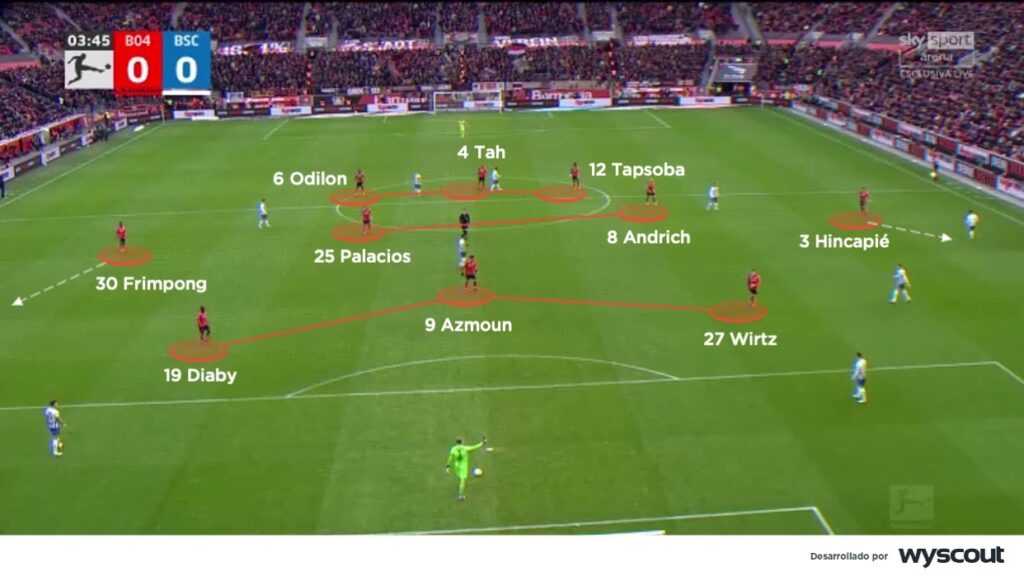
Usually one of the front three is responsible for man-marking the oppositions central pivot. In this case Azmoun is the one assigned. However, other players have fulfilled this role before. In the next example Hlozek is the one assigned to the role.

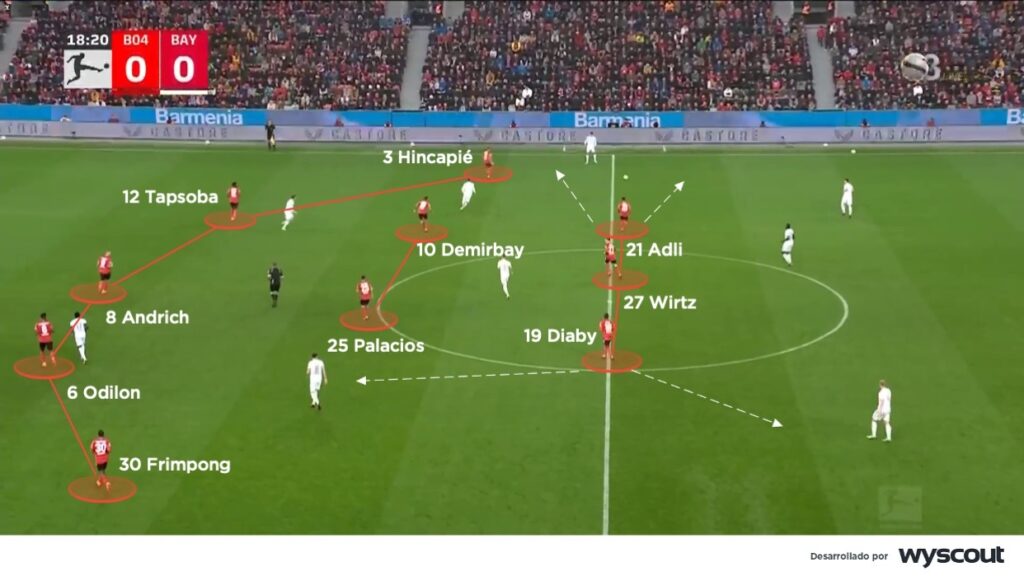
In a more settled defensive shape, Xabi Alonso organizes Leverkusen in a 5-2-3, with the wing-backs expected to tuck into a back five. The team adopts a more compact approach in order to reduce the oppositions freedom between lines.

An interesting variation of the 5-2-3 shape is when Leverkusen adopt a very aggressive mid block. Notice how Grimaldo (left wing-back) jumps onto the oppositions fullback, which starts out wide and tucks centrally. This movement is covered by Hincapié (playing as left center-back).
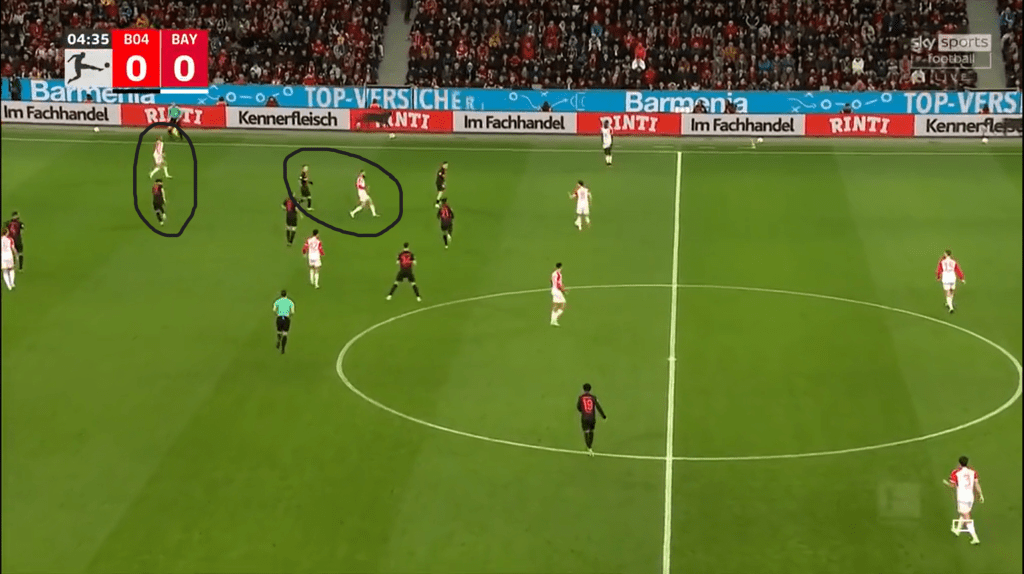
The same dynamics exist when Tapsoba and Hincapié are the ones responsible for the left side of the defense, notice how when Hincapié presses, Tapsoba is the one responsible for shifting across and covering the space behind the left wing-back.
Positional and fluid attack
In the settled attack phase, Leverkusen employ a positional 3-2-5. The wing-backs are expected to be high and wide, acting as the teams width. The team also creates a box midfields, with the double pivots, and both 10s occupying the half spaces.
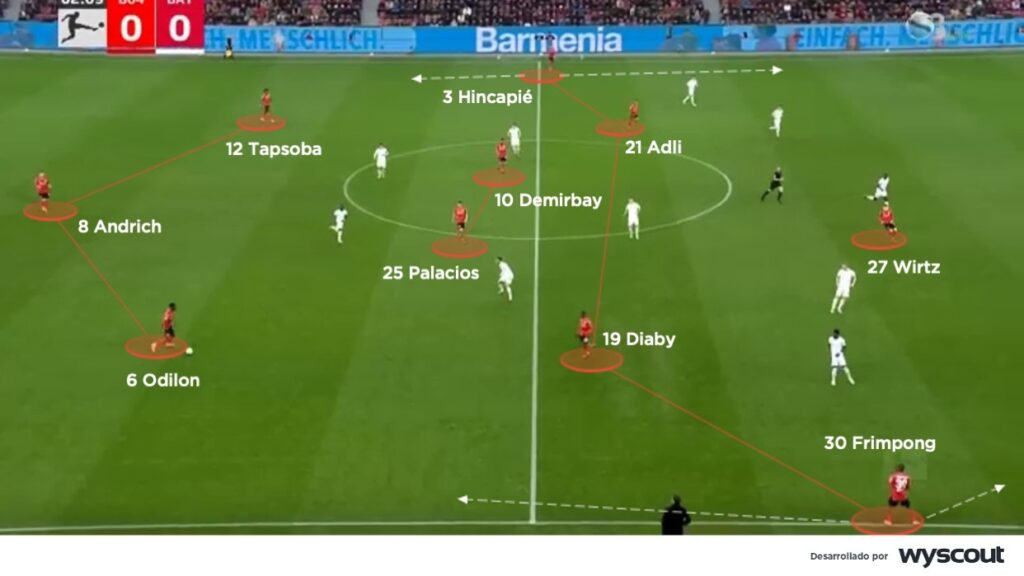
But what differs the team from other positional teams, is the fluidity, especially during build-up. In the example below, Leverkusen look to build out in their 3-2-5 structure.
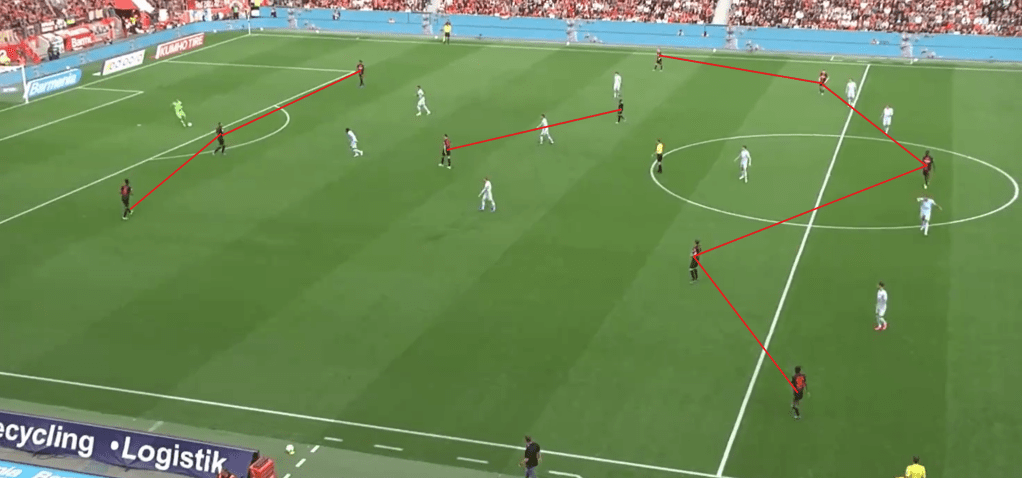
However, as Tapsoba gets pressured, Jonas Hoffman is willing to check in and leave his assigned position in order to form a triangle to help recycle possession, something which is uncommon for other positional teams.
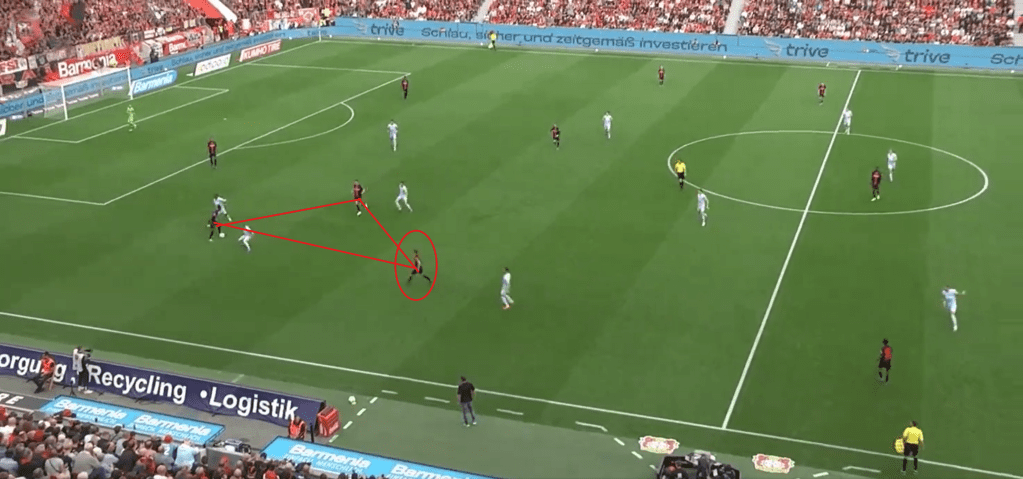
Later as the play develops, another positional dynamic is showed. Frimpong which starts the play in the right wide channel, ends up shifting to the right half-space, and Hoffman who starts in the right half-space roams to the right wide channel, again displaying just how fluid Xabi’s side is
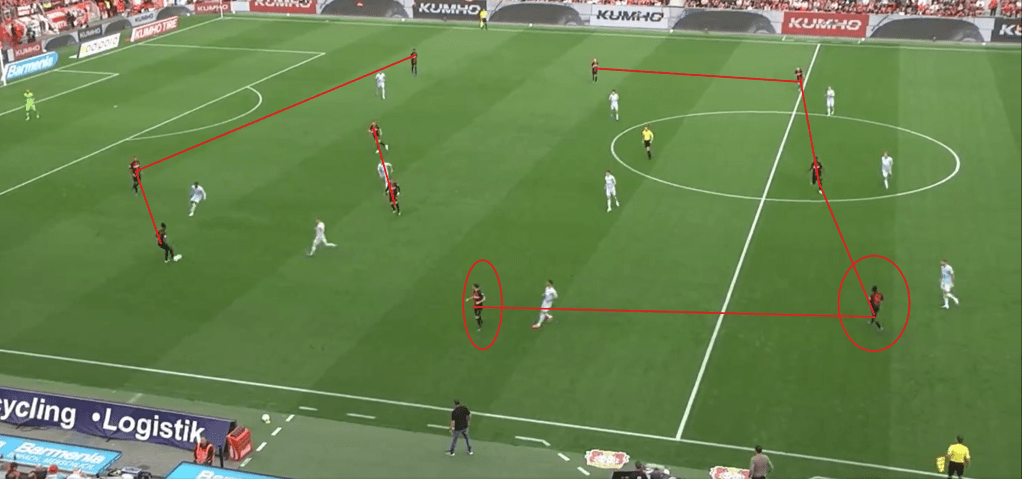
Leverkusen conduct their initial buildup with a lower temp, meticulously looking for an opening. However, when Bayer find an opening they speed up play and transition extremely fast. The trigger to speed up the game is when one of the pivots receives the ball with space and time in front of him.
When the pivot receives the ball with acres of space in front of him, Leverkusen look to go vertical and the front 5 are expected to make forward runs. The wing-backs sprint forwards while the 10s (usually Wiertz) moves centrally hoping to drag a defender with him.
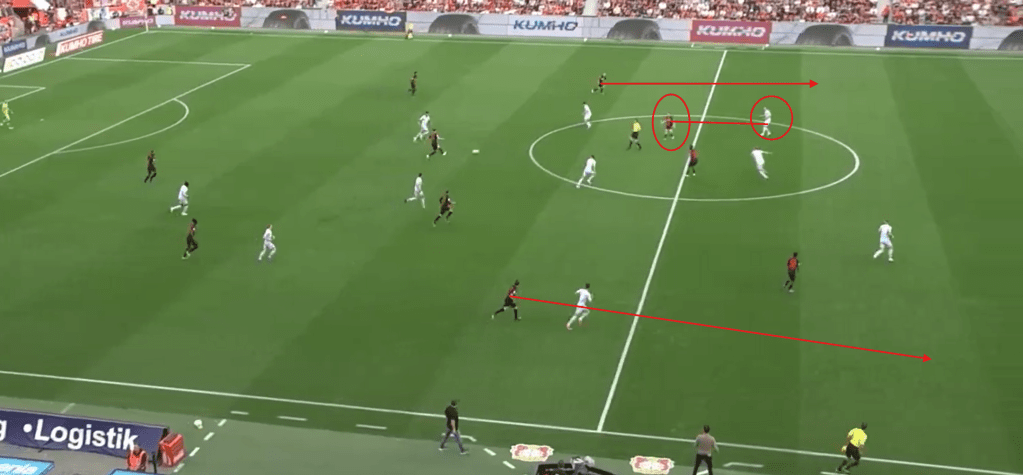
Wiertz’s central run in this example not only drags the left back central, it forces the center-back to jump, freeing up space for Boniface to exploit behind the center-back.
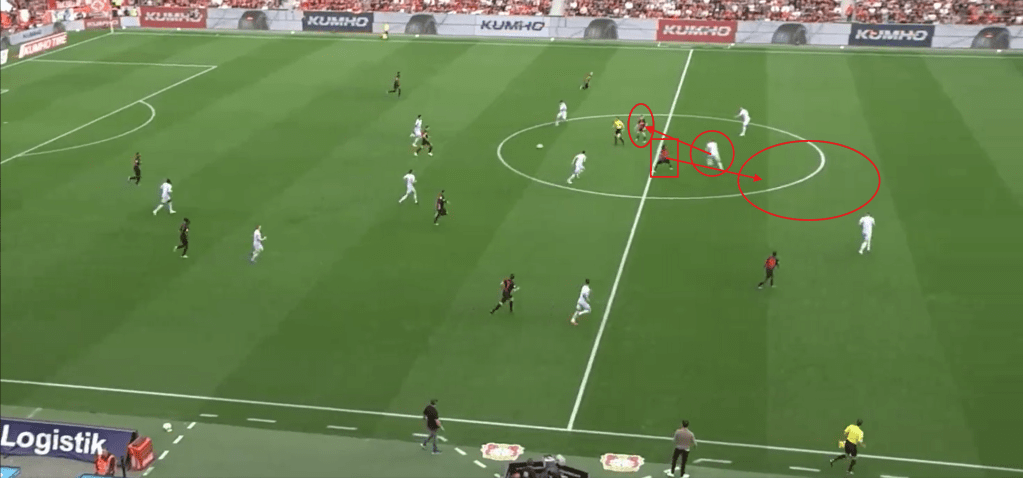
Boniface then carries the ball forward into a 4v4 situation on goal. However a misplaced ball to Grimaldo allows the opposition to recover opposition.

Even if this specific play did not translate into a goal, it perfectly encapsulates what Xabi Alonso wants from his player. A meticulous build-up in a very fluid 3-2-5 structure, that is verticalized when one of the pivots is able to receive the ball with space to play in front of him. This is the signal for the front 5 to make their runs. Wirtz comes central, while Frimpong and Grimaldo sprint forward from their wide positions.

 The Soccer Playbook
Deixe um comentário